STARDUST
Denise Scott Brown's obsession. Grace Silver's atomic logotype.
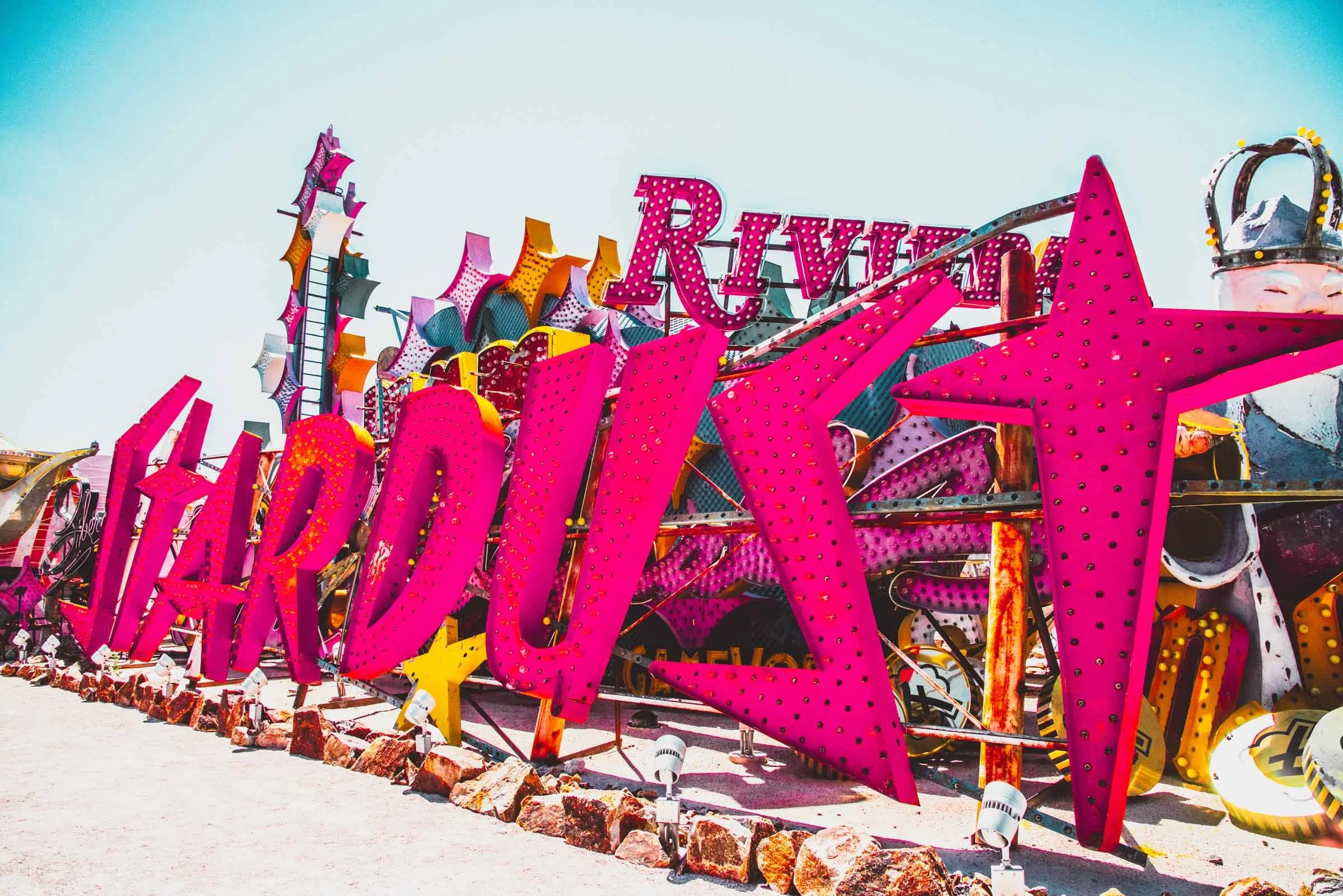
When Grace Silver's husband brought her the name "Stardust" in 1954, she — a child prodigy turned amateur designer — conceived the "outer space lettering" that would define an era. Four years later, on the night Sputnik changed the world, Kermit Wayne wrapped an entire building in her atomic dream: 7,100 feet of neon, 11,000 bulbs, stars bursting like a chain reaction visible from 60 miles away.
In 1968, Paul Miller topped it with an 188-foot tower of pastel starbursts — $500,000 worth of glass and gas reaching for the Nevada sky. Denise Scott Brown photographed it obsessively that year, seeing what others dismissed: commercial vernacular as cultural artifact, "decorated shed" as legitimate architecture.
Behind the sign, Frank "Lefty" Rosenthal ran the most sophisticated skimming operation in mob history while hosting a TV show from the casino floor. When it all came down in 2007, the Neon Museum spent $150,000 rescuing the letters. Atomic Age dreams die hard.
↓ Explore the Complete Story Below
-
Official Name: Stardust Resort & Casino Signage
Components: Two major iterations:1958 Original: Facade and roadside sign (Kermit Wayne/YESCO)
1968 Mega-Pylon: 188-foot tall freestanding sign (Paul Miller/Ad-Art) — likely the sign in Ludo's photo "Stardust Power"
Original Business: Stardust Resort & Casino
Years Active: July 2, 1958 – November 1, 2006 (48 years)
Original Address: Las Vegas Strip (north side), Las Vegas, Nevada1958 Original Sign
Designer: Kermit Wayne (YESCO - Young Electric Sign Company)
Logotype Designer: Grace Silver (1954) - original atomic-style lettering concept. Grace Silver was wife of consultant Bill Silver and amateur creative designer who designed the "outer space lettering concept" for Tony Cornero's Stardust name
Specifications:216-foot-wide facade covered with flashing light bulbs, neon tubing, simulated stars and planets against painted lunar background
7,100 feet of neon tubing with over 11,000 bulbs along 216-foot front. The 'S' alone contained 975 lamps. Visible from 60 miles away at night
1968 Mega-Pylon (THE iconic sign)
Designer: Paul Miller (Ad-Art sign company)
Rendering Artist: Chuck Barnard (Ad-Art)
Specifications:188 feet tall by 90-93 feet wide — record height at installation
Featured beautiful pastel multicolored plume of four-pointed stars rising into gleaming desert sky
Original cost: $500,000 (1968)
1991: Original atomic lettering replaced with Helvetica font. Original lettering given to Neon Museum, refurbished 2020
Museum Acquisition:
Neon Museum spent more than $150,000 rescuing the Stardust sign letters when casino demolished in 2007
Roadside sign dismantled February 2007, given to Neon Museum
Re-illuminated March 2020 with original Kermit Wayne space-age font design
-
The Stardust Casino (1958-2006)
Founder & Early History:
Tony "The Hat" Cornero (1899-1955) conceived the Stardust in early 1950s, originally naming it "Starlight". In 1954, after seeing growth of hotels on Las Vegas Strip, Cornero paid $650,000 for 36 acres on Strip's north side.By summer 1955, hotel was in final stages with 1,000 rooms built. Cornero faced battle for gambling license and SEC investigation into Stardust stock sales. He suffered a heart attack on casino floor at Desert Inn on July 31, 1955, and died hours later. Stardust stock including 650,000 shares owned by Cornero was deemed worthless in bankruptcy court.
Opening Day - July 2, 1958:
The space-age themed Stardust opened July 2, 1958. Original sign built by YESCO stood as world's largest cantilever at opening, with nighttime visibility reported three miles away.Hotel contained over 1,000 guest rooms (world record), largest swimming pool in Nevada (105 feet long), and largest casino (16,000 square feet). Also included Horseman's Park — rodeo complex with corrals for 300 horses.
Entertainment Legacy:
The Café Continental Stage was most technically advanced stage in Las Vegas at time, with latest lighting/sound equipment and hydraulic lifts raising performers 10 feet above and 30 feet below stage.Lido de Paris — iconic French-style revue opened on Stardust's opening day in 1958, ran for 32 years, helped solidify showgirl as symbol of Las Vegas culture. Choreographer Donn Arden imported French dancers, first topless performers on Las Vegas Strip.
The Mob Era (1970s-1980s)
In 1974, Argent Corporation bought Stardust using loans from Teamsters Central States Pension Fund. Though owned by Allen Glick, casino was believed controlled by various organized crime families from Midwest, particularly Chicago Outfit.
Frank "Lefty" Rosenthal ran the Stardust (along with Fremont, Marina, Hacienda) for Chicago Outfit from 1974-1981, despite never having official gaming license from Nevada Gaming Commission.
Over six years, Argent Corporation siphoned off between $7-15 million using rigged scales in massive skimming operation. When uncovered by FBI, it was largest skimming scheme ever exposed, leading to major RICO case known as "Strawman Case" with over dozen high-ranking mob figures convicted.
The End:
Stardust closed November 1, 2006 when Boyd Gaming announced closure to make way for Echelon Place mega-resort development. Stardust was imploded March 13, 2007. -
GRACE SILVER: Hidden Women Pioneer
The original Stardust atomic logotype was designed in 1954 by Grace Silver — wife of consultant Bill Silver, mother of future Gaming Control Board member Jeffrey Silver. Grace was a child prodigy, artist, and amateur creative designer.
According to her son Jeffrey Silver years later: "My dad brought her the name [Stardust by Hoagy Carmichael] and Grace came up with the outer space lettering concept." The lettering bears resemblance to original Metropolis movie poster designed in late 1920s.
Hidden from History: Grace Silver designed one of the most iconic logos in Las Vegas history, yet her contribution remained largely unknown for decades — another woman erased from neon sign design history alongside Betty Willis.
ATOMIC CULTURE & POST-WAR AMERICA
"Atomic tourists" actually came to Las Vegas to watch nuclear tests. U.S. government began above-ground testing at Nevada Test Site in 1951, and by mid-1950s, Vegas incorporated these detonations into tourism strategy. City went from "Gateway to Boulder Dam" to "Atomic City".
Stardust sign was massive, animated, drenched in nuclear symbolism: electrons swirling, stars bursting, lights pulsing like chain reaction. The Space Age began with Sputnik launch in 1957, and Stardust embodied exploration and scientific progress themes.
"If you just take the Stardust, it was really the first time that architecture, design and advertising all came together in one building. The sign was the building, and it was an advert for itself, which articulated this fantasy of the atomic age. The font, which became known as Atomic, broke all the lettering design rules at the time".
TRANSITIONAL MOMENT IN AMERICAN HISTORY
Stardust represents pivotal moment in Las Vegas history: city's transition from mob dominance to corporate ownership. When skimming was exposed, it triggered permanent transformation. Major corporations moved in, ushering in era of massive resorts and publicly traded casino companies.
-
Original Construction (1958 & 1968)
1958 YESCO Fabrication:
YESCO designed and built massive Stardust sign and fascia covering entire front of building with flashing light bulbs, neon tubing, simulated stars and planets against painted lunar background (1958).1968 Ad-Art Mega-Pylon:
Paul Miller's concept for Ad-Art "topped out at record height of 188 feet, first presented using blackcard rendering by Chuck Barnard. Miller's design evolved after numerous competing sign firms' presentations were rejected".Endangered Craftsmanship
YESCO still restores vintage neon signs, and its technicians are some of last artisans trained in classic tube-bending and hand-lettering techniques. This respect for history combined with eye toward future keeps YESCO relevant.
YESCO built reputation on neon but never stood still. They moved from glass tubing to incandescent bulbs, then LEDs, full-color displays, programmable digital signage. Today install 100-foot-high video walls, but neon never went out of style.
2007 Museum Rescue & 2020 Restoration
The Neon Museum spent more than $150,000 rescuing letters of Stardust sign when casino demolished in 2007, giving it pride of place among countless other classic Vegas neons.
Re-illuminated March 2020, Stardust Hotel & Casino signage features distinctive space-age font designed by YESCO artist Kermit Wayne.
-
UNLV Special Collections (Extensive):
Stardust Resort and Casino Records (1950-2006)
MS-00515: Materials on events, corporate history, interior/exterior design, performers
Photographs, negatives, slides documenting resort history
VHS tapes, audio cassettes, film reels, commercials
Stardust Resort and Casino Photograph Collection (1957-2001)
PH-00319: Visual history of resort including sign, hotel towers, pools, interiors
Vintage Las Vegas Archive (Comprehensive)
https://vintagelasvegas.com/ - Multiple entries with photos from 1954-2007
Construction photos, signage installation, demolition documentation
Denise Scott Brown Photography (1968-1971):
Learning from Las Vegas Studio Archives
Denise Scott Brown photographed Stardust multiple times between 1968-1971. Limited edition prints available through Aperture
Venturi, Scott Brown & Associates Archives
Stardust Hotel and Casino Neon Sign, Las Vegas, 1968 — part of Yale studio documentation that led to 1972 "Learning from Las Vegas" book
Professional Photography:
Carol M. Highsmith Archive (Library of Congress)
Historic Stardust sign photography (between 1980-2006)
Chuck Barnard Collection (Neon Museum)
Collection from Ad-Art sign company dating 1960s-1980s, documenting creation of famous Vegas signs, notably 1968 Stardust pylon. Includes photograph flipbook of Stardust sign illumination sequence from 1980 by William Hannapple
-
Film - CASINO (1995)
Martin Scorsese's "Casino" (1995) — fictional Tangiers resort reflected story of Stardust Resort and Casino. Film stayed remarkably true to real-life story of mob control of Stardust. Based on Nicholas Pileggi's book "Casino: Love and Honor in Las Vegas".
Cast & Characters:
Robert De Niro as Sam "Ace" Rothstein (based on Frank "Lefty" Rosenthal who ran Stardust 1974-1981)
Joe Pesci as Nicky Santoro (based on mob enforcer Anthony Spilotro)
Sharon Stone as Ginger McKenna (based on Geri McGee, Rosenthal's wife) — Oscar nomination, Golden Globe win
Filming:
Filmed at Riviera Casino in Las Vegas with defunct Landmark Hotel as entrance to replicate fictional Tangiers. Scorsese filmed around actual casino rather than construct set.Hoagy Carmichael's song "Stardust" can be heard on soundtrack, giving subtle hint as to casino's true identity despite name change to "Tangiers" for legal purposes.
Academic - LEARNING FROM LAS VEGAS (1972)
Robert Venturi, Denise Scott Brown, and Steven Izenour's "Learning from Las Vegas" included several studies of 1968 roadside sign for Stardust.
"In architectural terms, the Stardust is a 'decorated shed' — term that architects Venturi, Scott Brown and Izenour define in Learning from Las Vegas to describe building designs combining 'rhetorical front' decorated with symbols and 'conventional behind' providing shelter".
Other Media:
Frank Rosenthal hosted "The Frank Rosenthal Show" in 1977 from Stardust hotel — exactly as depicted in Casino film
Television series "Crime Story" (1980s) — Stardust was regular filming location
Films: "Showgirls" (1995), "Swingers" (1996), "Fear and Loathing in Las Vegas" (1998) as fictional "Bazooko Circus"
-
Commercial Vernacular as Cultural Artifact
"While neighboring resorts celebrated exotic and western motifs, Stardust was 'Tomorrowland of Las Vegas.' Its 1968 replacement sign in shape of atomic cloud that Las Vegas was famous for in '50s was one of greatest examples of roadside signage ever".
Denise Scott Brown photographed Stardust multiple times between 1968-1971. This photograph with "wonderfully indulgent hues and maximalist, iconic signage" encapsulates architecture, atmosphere, and pop culture that drew Scott Brown's interest to rapidly growing Las Vegas in 1960s.
The Yale Studio (1968):
In 1968, Robert Venturi, Denise Scott Brown, and Steven Izenour made Las Vegas their classroom. Together with students from Yale University, they photographed Stardust as they documented archetypal commercial strip at its "most heroic and ordinary"."Las Vegas Studio" photos reveal contrast between city's nighttime magic and daytime dowdiness over and over, particularly in Stardust photos (which put architects and students up for free).
Atomic Age as Architectural Expression
Stardust embodied excitement of Space Age era. Sputnik launch in 1957 marked start of period, and its stylistic influence observed on everything from furniture to automobile design to Las Vegas signage.
"The font, which became known as Atomic, broke all lettering design rules at the time, and when you walked into building you could hear whirring mechanisms of the sign".
-
This photograph positions within several curatorial frameworks:
Academic Cornerstone: Learning from Las Vegas Denise Scott Brown and Robert Venturi photographed the Stardust obsessively for their groundbreaking 1972 study Learning from Las Vegas. This sign is THE academic anchor for legitimizing commercial vernacular architecture as serious cultural artifact. Any institution collecting this work inherits 50+ years of architectural theory.
Women Pioneers: Grace Silver Grace Silver designed the Stardust's iconic atomic logotype in 1958—yet remains virtually unknown. In the male-dominated 1950s sign industry, women artisans like Silver shaped Las Vegas's visual identity without recognition. This photograph recovers her contribution.
Atomic Age Cultural Artifact The Stardust's cosmic imagery (planets, stars, Futura font) embodies post-war American optimism—Space Race enthusiasm translated into commercial vernacular. This is material culture documentation of mid-century American identity.
Transitional Moment: Mob to Corporate The Stardust witnessed Vegas's transformation from organized crime (1960s-80s skim scandals, basis for Casino film) to corporate consolidation. Its 48-year history documents American capitalism's evolution.
Relevant for collections focusing on:
Architectural studies (Denise Scott Brown legacy)
Women pioneers in commercial art
Mid-century American visual culture
Post-war optimism and Atomic Age
Documentary photography tradition
Institutional Alignment:
SFMOMA: Learning from Las Vegas centerpiece, vernacular photography
Getty Museum: California/Western American photography
Centre Pompidou: Women designers + European fascination with American commercial culture
Architecture museums: Decorated shed theory exemplar
-
Primary Sources:
The Neon Museum Official - https://neonmuseum.org/12422-2/ (Stardust Hotel & Casino page)
The Neon Museum - https://neonmuseum.org/news/neon-and-nuclear-how-atomic-culture-influenced-vegas-design-in-the-50s/
The Neon Museum - https://neonmuseum.org/news/meet-yesco-the-company-behind-much-of-vegas-glow/
The Neon Museum - https://neonmuseum.org/news/stardust-sign/ (Chuck Barnard collection)
The Neon Museum - https://neonmuseum.org/news/designs-decoded-technical-drawings-from-federal-heath/
The Neon Museum - https://neonmuseum.org/news/how-many-of-the-signs-light-up/
YESCO Official - https://www.yesco.com/the-neon-story/
YESCO - https://www.yesco.com/yesco-and-the-neon-museum-las-vegas/
UNLV Special Collections:
Stardust Resort and Casino Records (MS-00515) - https://special.library.unlv.edu/ark:/62930/f1wt0f
Guide to Stardust Records (PDF) - https://special.library.unlv.edu/sites/default/files/finding-aids/MS-00515.pdf
Stardust Resort Photograph Collection (PH-00319) - Multiple items
UNLV Digital Collections - Postcards, interior photos, casino documentation
Learning from Las Vegas Sources:
Aperture (Denise Scott Brown Print) - https://aperture.org/prints/new/stardust-las-vegas-c-1968/
Artspace (Scott Brown Print) - https://www.artspace.com/denise-scott-brown/stardust-las-vegas-c-1968
Visualising Lost Theatres - https://losttheatres.net/stardust (Architectural analysis with UNLV sources)
Historical Documentation:
Wikipedia - Stardust Resort and Casino - https://en.wikipedia.org/wiki/Stardust_Resort_and_Casino
Wikipedia - Casino (1995 film) - https://en.wikipedia.org/wiki/Casino_(1995_film)
Library of Congress (Carol Highsmith) - https://www.loc.gov/item/2011631018/
NPR - https://www.npr.org/2007/03/13/7854907/vegas-bids-farewell-to-the-stardust
Vintage Las Vegas - https://vintagelasvegas.com/ (Multiple comprehensive posts)
Flickr (Chuck Barnard rendering) - https://www.flickr.com/photos/14696209@N02/32195867777
Casino Film Sources:
The Review Magazine - https://www.thereviewmag.co.uk/casino-the-real-mob-story/
Den of Geek - https://www.denofgeek.com/culture/real-history-casino-martin-scorsese/
Cinephilia Beyond - https://cinephiliabeyond.org/casino/
Looper - https://www.looper.com/860350/everything-casino-doesnt-tell-you-about-the-true-story/
The Mob Museum - https://themobmuseum.org/popculture/casino-8/
Additional:
Las Vegas Advisor - https://www.lasvegasadvisor.com/question/2016-06-07/
Visit Las Vegas - https://www.visitlasvegas.com/experience/post/neon-glow/
Wonderful Museums - https://www.wonderfulmuseums.com/museum/the-neon-museum-las-vegas-nevada/