GOLDEN NUGGET
80 years on Fremont Street. The oldest casino in Vegas
In August 1946, a corrupt LA cop on the run built Vegas' largest casino—and accidentally created an American icon.
Guy McAfee, former LAPD Vice Squad captain turned syndicate operative, fled California's reform crusade with $1 million and a dream: the Golden Nugget, a Victorian fantasy wrapped in Western mythology.
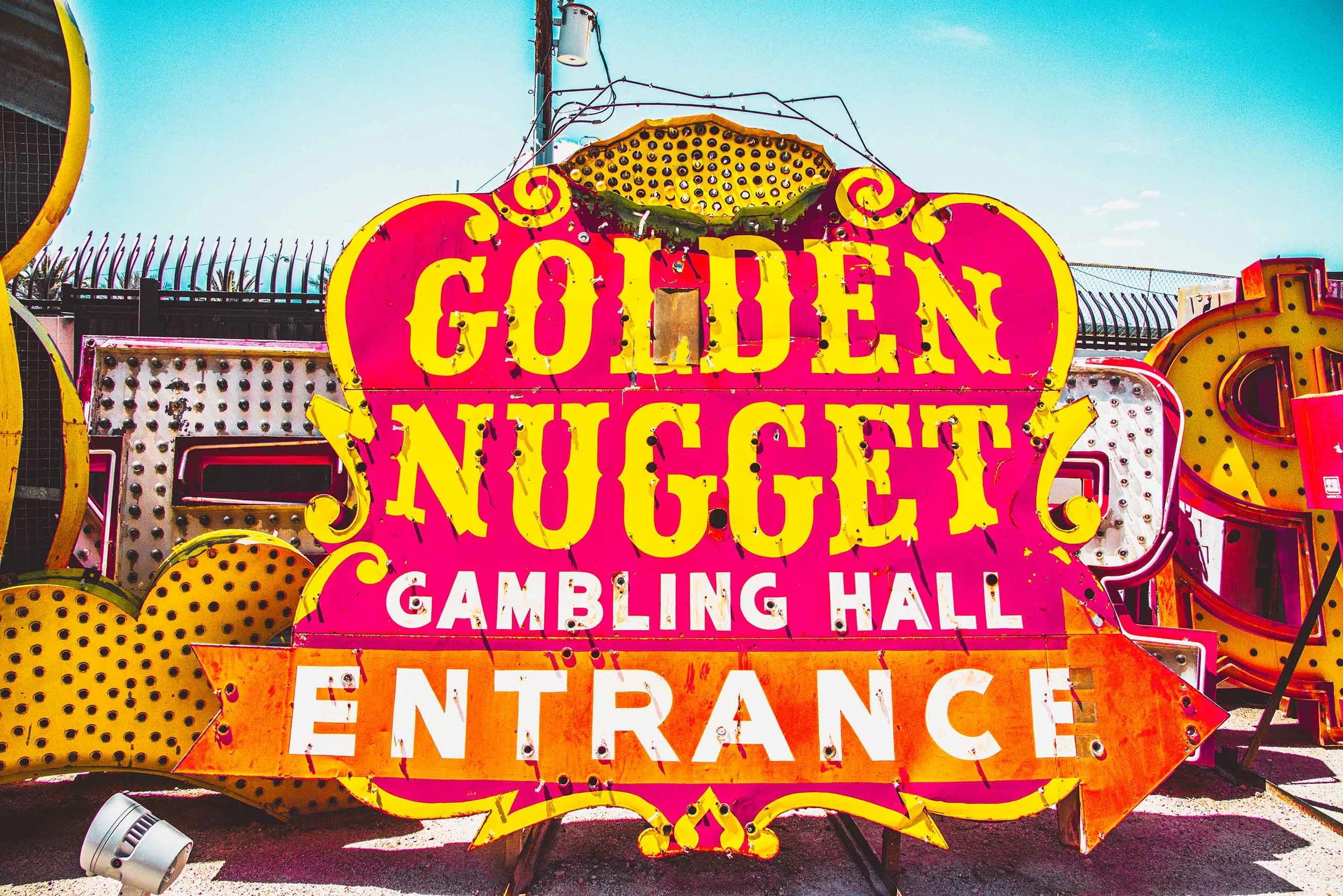
When Kermit Wayne's 1956 neon spectacular wrapped the building in golden yellow, red, and blue, it became architecture's perfect rebellion—the "decorated shed" that Denise Scott Brown would celebrate in Learning from Las Vegas as commercial vernacular's answer to modernist elitism. Hand-bent by endangered artisans like Oscar Gonzalez (30+ years at YESCO, one of only 3 benders left), each glass tube represents a dying craft—open flame, burnt fingers, 16-hour days.
Still glowing on Fremont Street 79 years later, the Golden Nugget isn't nostalgia. It's proof that America's most authentic art was never in museums—it was selling you a dream from the desert highway.
↓ Explore the Complete Story Below
-
Official Name: Golden Nugget Gambling Hall / Golden Nugget Casino
Original Business: Golden Nugget Casino
Years Active: August 30, 1946 – Present (still operating, 79 years)
Original Address: 129 Fremont Street (corner of Fremont & Second Street), Downtown Las Vegas
Designer Evolution:1946: Dick Porter (YESCO) – Original Western-vernacular design
1950: Hermon Boernge (YESCO) – "Gilded age gingerbread" with golden nugget on top, 48' x 48' open frame
1956: Kermit Wayne (YESCO) – Iconic wrap-around "bull-nose shield" design (golden yellow, red, blue)
1958: YESCO "neon spectacular" version
Museum Acquisition: The Neon Museum collection includes Golden Nugget signage. The first "N" in the museum's entrance sign is styled after the Golden Nugget's iconic typography.
Physical Specs: 1956 version wrapped upper floors in neon + incandescent bulbs. Touted as "largest and brightest sign in the world" in 1949. -
YESCO (Young Electric Sign Company)
Founded 1920 by Thomas Young (English immigrant, Ogden, Utah). Established Las Vegas operations 1932, opened branch 1945. Created the "Golden Age of Neon" on Fremont Street ("Glitter Gulch").
Key Designers:
Hermon Boernge (1905-1990s)
YESCO's first art director in Las Vegas (1946)
Born January 17, 1905, Corralitos, CA
Relocated to Las Vegas 1946, hired full-time by Jack Young
1950 Golden Nugget design: Incandescent "gilded age gingerbread" with golden nugget topper, 48' wide and tall – set standard for "bigger & brighter" on Fremont
Also designed: Mint, Binion's Horseshoe, Flamingo, Sands, Desert Inn, Pioneer Club's Vegas Vic
Close collaborator with Kermit Wayne
Stepped down as art director 1964/1965 (heart issues) but continued as artist
Kermit Wayne
Innovative designer, YESCO
1956 Golden Nugget "spectacular": Wrap-around "chasing, scintillating, bull-nose shield design" of ornate golden yellow, red, and blue
Ten years after opening, wrapped upper floors in neon + incandescent bulbs
This version celebrated in Learning from Las Vegas as exemplar of "decorated shed"
Dick Porter
YESCO designer
1946 original Golden Nugget: Western-vernacular style echoing San Francisco Gold Rush days
Design Philosophy:
Victorian carved wood + Italian marble interior (fixtures 50+ years old), replicating original Golden Nugget bar on San Francisco's Barbary Coast during Comstock silver rush (mid-1800s).
-
Guy McAfee: The Dirty Cop Who Built a Dream
August 30, 1946: Guy McAfee (age 58) opened the Golden Nugget with $1 million investment – largest gambling house in Las Vegas at the time. It debuted 4 months BEFORE Bugsy Siegel's Flamingo (December 26, 1946).
Background:
Former LAPD Vice Squad Captain (1920s-1930s)
Corrupt cop: Simultaneously ran illegal gambling houses, saloons, brothels in Los Angeles while heading vice squad
Owned Clover Club on Sunset Boulevard (Hollywood hotspot)
Member of LA crime syndicate
1938: Fled LA after reform mayor Fletcher Bowron elected to crack down on corruption
Married movie actress June Brewster (divorced 1941)
Coined "The Strip": Named Highway 91 after LA's Sunset Strip (bought Pair-O-Dice casino 1939)
Golden Nugget as Power Play:
Touted as "world's largest casino" at opening
No-limit poker games until 1950 (first casino to introduce center dealer)
Victorian opulence meets Western mythology
Mob associations: Moe Sedway (Meyer Lansky associate) photographed at Golden Nugget
Post-McAfee Era:
1950: Converted to public corporation, McAfee as president
1960: McAfee retired and died same year
1972: Steve Wynn (age 30, youngest casino owner in Vegas) bought controlling stake
1977: First hotel tower opened, received first 4-diamond rating for downtown property
1982: Wynn convinced Frank Sinatra to perform downtown (major coup for Fremont Street)
1984: Sinatra + Willie Nelson at Theater Ballroom
Still operating today under Landry's Inc.
-
The Neon Benders: Endangered Artisans
Oscar Gonzalez – "The Lightbearer"
Mexican neon bender, started age 14 in Guadalajara shop
30+ years at YESCO Las Vegas
Trained by father and grandfather (multi-generational craft)
One of only 3 neon benders left at YESCO (down from 8 in 1990s)
Featured in Neon Museum Oral History Project
Hand-bent glass tubes using open flame: 8 hours to make first simple sign ("vino")
Dangerous, painstaking work: "The more burns you got, the better you're getting"
Craft in Crisis:
By 2011: YESCO had 3 benders left (from 8 full-time + overtime in 1990s)
Casino Lighting & Sign: 2 benders left (from 5 in 1998)
No new apprentices – endangered species
Replaced by LED technology (cheaper, more flexible, but soulless)
Eric Elizondo (YESCO):
35 years experience, 3rd-generation bender
Father Sergio made neon for original "Welcome to Fabulous Las Vegas" sign
Son laid off – 4th generation lost
Learning from Las Vegas: Cultural Legitimacy
1968: Robert Venturi, Denise Scott Brown, Steven Izenour study Las Vegas Strip with Yale students
1972: Publish Learning from Las Vegas: The Forgotten Symbolism of Architectural FormGolden Nugget as "Decorated Shed":
Kermit Wayne's 1956 wrap-around design exemplifies "decorated shed" concept
"Decorated Shed": Building where ornament is applied independently of structure and program
Opposed to "Duck": Building where form and volume express meaning
Commercial vernacular architecture as legitimate cultural artifact
Symbolism over form – Vegas as apotheosis of American commercial vernacular
Academic Positioning:
Mayor Oscar Goodman: "Neon is to Las Vegas what jazz is to New Orleans." -
Neon Bending Techniques:
Hand-bent glass tubing rotated over open flame until pliable
Artisan blows into hose connected to tubing to prevent collapse
Glass "dances under heat" – requires constant movement to keep level
Bent into desired shape when ready
Labor-intensive: 16-hour days in peak era (1998)
Multi-year apprenticeship required
Golden Nugget Sign Evolution:
1946: Original sign by Dick Porter
1948 (September): Rooftop sign constructed by YESCO
1949: New neon sign with "shining neon nugget" topper
1950: Hermon Boernge's 48' x 48' "gilded age" version
1956: Kermit Wayne's wrap-around spectacular
1984 (December): Rooftop sign removed during facade remodel
Current Status:
Golden Nugget signs (multiple versions) preserved at Neon Museum Boneyard. Original typographic style used as first "N" in museum entrance sign – testament to iconic design.
-
Primary Sources:
Library of Congress:
Carol M. Highsmith Collection: Golden Nugget historic casino sign (Between 1980-2006)
4x5 color transparency, high-resolution digital scan available
UNLV Special Collections & Archives:
Arthur G. Grant Photograph Collection
Multiple views 1940s-1960s Fremont Street with Golden Nugget
Vintage Photos:
1946: Burton Frasher Sr. – Opening day Golden Nugget
1948: Golden Nugget with new rooftop sign
1950s: "Glitter Gulch" era with Hermon Boernge design
1960s: Kermit Wayne wrap-around spectacular in full glory
1966: Vintage negative film scans showing iconic yellow/red typography
Contemporary Sources:
Neon Museum collection photos
YESCO archives (100+ years of sign history)
Fremont Street Experience documentation
-
Movies:
Vegas Vacation (1997) – YESCO Boneyard featured
Generic "old Vegas" establishing shots (Fremont Street)
Academic:
Venturi, Robert; Scott Brown, Denise; Izenour, Steven (1972). Learning from Las Vegas: The Forgotten Symbolism of Architectural Form. MIT Press. [Golden Nugget 1956 version exemplifies "decorated shed" concept]
Hess, Alan. Viva Las Vegas: After-Hours Architecture
Tom Wolfe (1965). "Las Vegas (What?) Las Vegas (Can't hear you! Too noisy) Las Vegas!!!!" – defining New Journalism essay
Exhibitions:
2009-2010: "What We Learned: The Yale Las Vegas Studio" – Yale School of Architecture (traveled to Museum im Bellpark, Deutsches Architekturmuseum Frankfurt)
2022: "Lighting Up Las Vegas: YESCO Marks a Glittering Century" – Clark County Museum + Neon Museum (May-August)
-
Commercial Vernacular as Cultural Artifact
Venturi & Scott Brown Thesis (1972):
"The decorated shed is the conventional shelter that applies symbols… The duck is the sculptural symbol. Las Vegas shows the decorated shed to be the norm and the duck to be the exception."Golden Nugget (1956) as Decorated Shed:
Basic building structure (generic casino/hotel)
Wrap-around neon signage as applied ornament (Kermit Wayne's "bull-nose shield")
Symbolism independent of building form
Typography + color (yellow/red/blue) convey meaning
Bigger = better on automobile-scale Strip
Why This Matters for Museums:
Legitimizes commercial signage as high art
Continuation of postmodernist architectural discourse
Walker Evans precedent: Documentary photography of "everyday America" (Depression-era vernacular)
Challenges modernist hierarchy (heroic monuments vs. "ugly and ordinary")
Pop Art parallel: Warhol's Campbell's Soup = Venturi's Golden Nugget sign
-
This photograph positions within several curatorial frameworks:
Decorated Shed Theory The Golden Nugget exemplifies Denise Scott Brown's architectural analysis from Learning from Las Vegas (1972). Kermit Wayne's 1956 wrap-around neon spectacular transformed a generic building into pure signage—the building became "all sign with hardly any building." This is the decorated shed in its purest form.
California-Nevada Mob Migration Guy McAfee, founder (1946), was a corrupt LAPD vice squad captain who fled California and coined the term "The Strip" after LA's Sunset Strip. The Golden Nugget documents the corrupt law enforcement pipeline that built early Las Vegas—California cops, politicians, and gangsters who transformed criminal knowledge into "legitimate" casino operations.
YESCO Craftsmanship Legacy Designed by Hermon Boernge (1950) and Kermit Wayne (1956), both legendary YESCO designers who created the visual language of mid-century Vegas. Their generation—including Betty Willis—were artisans whose work required years of apprenticeship.
Downtown vs. Strip Still operating after 79 years, the Golden Nugget represents Downtown Fremont Street's defiant authenticity against Strip spectacle. This is urban identity documentation.
Relevant for collections focusing on:
Architectural studies (decorated shed theory)
American organized crime history
Commercial vernacular as cultural artifact
Urban development and identity
YESCO artisan documentation
Institutional Alignment:
SFMOMA: Learning from Las Vegas decorated shed exemplar
Getty Museum: California-Nevada cultural exchange, mob migration history
Centre Pompidou: American commercial vernacular as cultural critique
Architecture museums: Venturi/Scott Brown theory in practice
-
Primary Sources:
The Mob Museum : Gangster-built Golden Nugget turns 70 (Nov 8, 2016)
Neon Museum Collections : Historic Las Vegas Project - Golden Nugget
YESCO History : Our History
Library of Congress : Carol M. Highsmith - Golden Nugget sign
PBS American Experience: Guy McAfee profile
Academic Sources:
6. Venturi, Robert; Scott Brown, Denise; Izenour, Steven (1972).Learning from Las Vegas: The Forgotten Symbolism of Architectural Form. MIT Press.
7. Neon Museum Las Vegas : Oscar Gonzalez | Neon Bender Oral History
8. Golden Nugget Playing Card History : Hermon Boernge & Kermit Wayne designersCraftsmanship Sources:
9. Las Vegas Weekly : The Lightbearer – Oscar Gonzalez
10. Las Vegas Sun : Nostalgia for neon remains, but light's nearly out
11. Classic Las Vegas : A Fading Art: Neon SignsHistorical Photos:
12. UNLV Digital Collections: Arthur G. Grant Photograph Collection
13. Vintage Las Vegas: Freemont Street https://vintagelasvegas.com/post/794276804477288449/1952