SAHARA HOTEL & CASINO
Milton Prell's "Jewel in the Desert." Beatles. Rat Pack. 59 years of history.
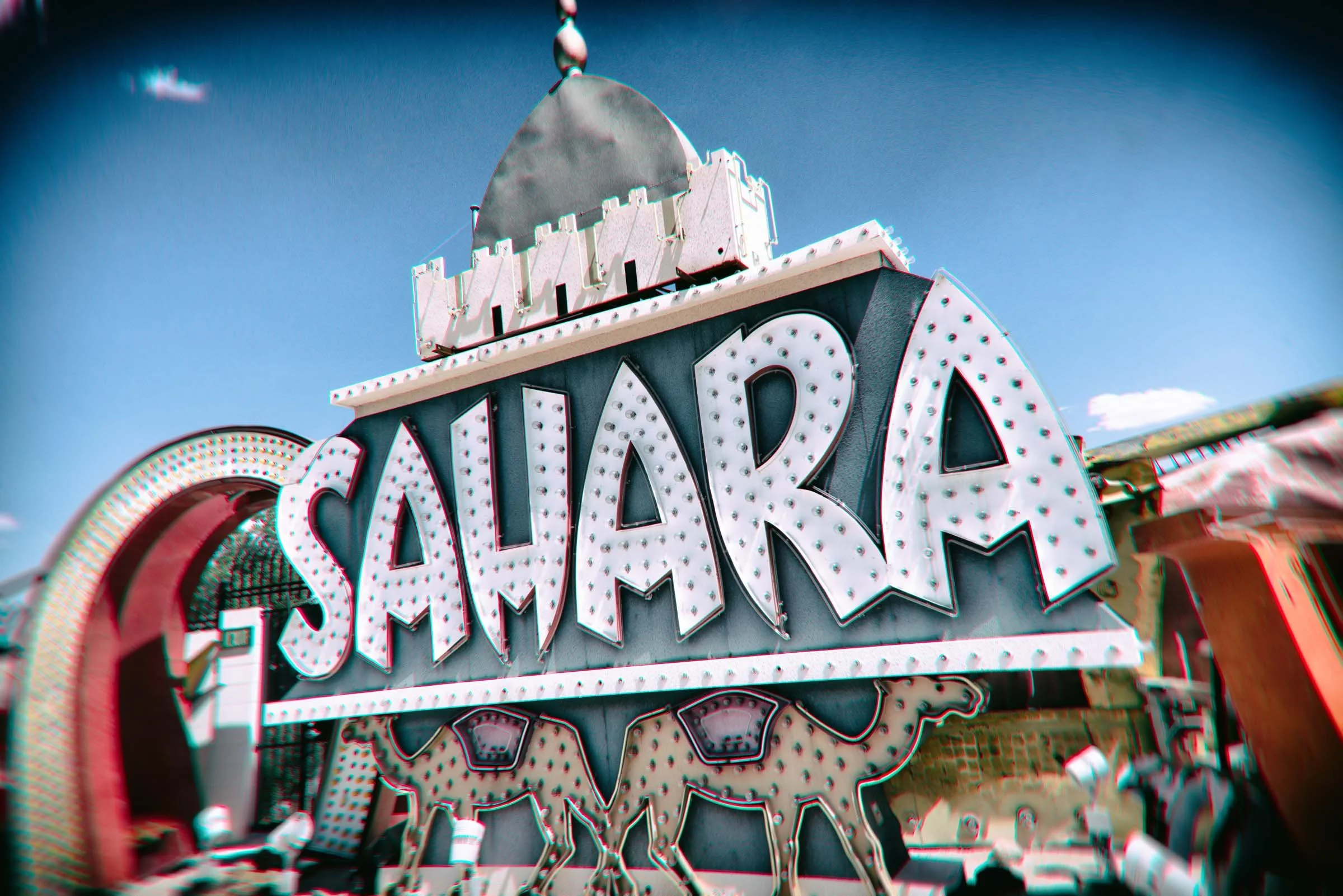
The Sahara Hotel & Casino sign, now resting in the Neon Museum's Boneyard, is more than a relic of 1950s glamour—it's a monument to America's post-war dreams and their eventual collapse.
Built in 1952 by Jewish entrepreneur Milton Prell as "The Jewel in the Desert," the Sahara became the epicenter of Rat Pack culture, hosting Louis Prima and Keely Smith's revolutionary lounge act, the filming of *Ocean's 11*, and the Beatles' legendary 1964 Vegas visit. Architects Denise Scott Brown and Robert Venturi legitimized its Moroccan fantasy architecture in *Learning from Las Vegas* (1972), recognizing the sign as culturally significant "decorated shed." Yet capitalism proved indifferent: the Sahara closed in 2011 after 59 years, victim of the Great Recession and shifting Strip economics.
Ludo Cazeba's photograph captures what remains—a museum-preserved memorial to demolished dreams, where YESCO's hand-bent neon tubes testify to endangered artisan craftsmanship and erased cultural memory.
↓ Explore the Complete Story Below
-
Official Name: Sahara Hotel & Casino (1952-2011)
Original Business: Sahara Hotel & Casino
Years Active: October 7, 1952 – May 16, 2011 (59 years)
Subsequent Rebranding:
- SLS Las Vegas (2014-2019)
- Sahara Las Vegas (2019-Present)
Original Address: 2535 South Las Vegas Boulevard (north end of the Strip)
Designer/Creator:
- Building Architect: Martin Stern Jr. (1956 expansion, 1960 14-story tower, 1963 24-story tower)
- Original Architect: Max Maltzmann (1952 opening), completed by Del E. Webb Construction Company
- Sign Designers: YESCO (Young Electric Sign Company)
- 1960: 127-foot vertical roadside sign
- 1980: 222.5-foot tall freestanding sign (world's tallest at the time, $1 million cost)
- 1990s: Paradise Avenue porte-cochère sign (currently in Neon Museum collection)
- 1997: New camel-themed neon signs (Las Vegas Strip entrance + Paradise Road rear entrance)
Current Museum Location:
The large Sahara sign displayed in the Neon Boneyard is from the 1990s and was originally installed over the porte-cochère (automobile entrance) along Paradise Avenue. Additional Sahara letters are scattered throughout the Neon Museum collection.
Museum Acquisition: Donated to the Neon Museum in June 2011 by SBE Entertainment Group following the property's closure.
Physical Specifications:
- 1990s porte-cochère sign (in Museum): Large-format lettering with neon and incandescent bulbs
- 1997 renovated entrance: $4.6 million Moroccan-style dome (140 feet high, 200 feet diameter)
- Famous camel sculptures: Neon and fiberglass constructions flanking entrances
Restoration Status: Partially restored; 2012 grand opening of Neon Museum featured restoration of portions of the original Sahara Hotel & Casino marquee
Sources:
- https://neonmuseum.org/12432-2/
-
### Martin Stern Jr. (Architect)
Full Name: Martin Stern Jr. (1917-2001)
Company: Martin Stern Jr. & Associates (Los Angeles-based)
Sahara Design Evolution:
- 1956: Designed 192-room Sahara Oasis Motel addition
- 1960: 14-story Sahara Tower (later Tunis Tower) — opened June 1960, adding 204 rooms
- Historic Significance: Tallest building in Nevada at the time
- Featured flashing electric clock on top displaying time and temperature
- Topped with large letter "S" sign
- 1963: 24-story Sahara Skyscraper Tower — 400 rooms
- Historic Significance: Tallest building in Nevada upon completion
- Construction began February 9, 1962
Other Notable Vegas Signs/Buildings by Martin Stern Jr.:
- The Sahara expansions defined his early Las Vegas career
- Stern became one of the most prolific Strip architects of the 1950s-1970s
Design Philosophy:
Stern pioneered the concept of high-rise hotel towers on the Strip, transitioning Las Vegas from low-rise motor inns to vertical casino-resort complexes. The Sahara's 1960 14-story tower was revolutionary—establishing the template for mid-century Vegas architecture.
### YESCO (Young Electric Sign Company)
Founded: 1920 by Thomas Young
Company: Young Electric Sign Company (Salt Lake City/Las Vegas)
Sahara Sign Evolution:
- 1960: 127-foot vertical roadside sign installed in front of the resort
- 1980: 222.5-foot tall freestanding sign — world's tallest free-standing sign at the time
- Cost: $1 million
- Remained iconic Las Vegas landmark for decades
- 1990s: Porte-cochère signage along Paradise Avenue (now in Neon Museum)
- 1997: New neon camel signs for Strip entrance + Paradise Road entrance (part of Bill Bennett's $100 million renovation)
YESCO Legacy:
YESCO designed and fabricated signs for virtually every major Vegas casino from the 1940s-1990s, including the Stardust, Golden Nugget, Caesars Palace, Sands, Desert Inn, and dozens more. The company donated retired signs to the Neon Museum in 1996, establishing the Boneyard collection.
Sources:
-
### "The Jewel in the Desert" (1952-1970s)
The Sahara Hotel & Casino opened on October 7, 1952, as the sixth resort on the Las Vegas Strip. Built by Milton Prell—a Jewish entrepreneur from St. Louis who had previously operated the successful Club Bingo on the same site (1947-1951)—the Sahara epitomized post-WWII American optimism and the boom of the entertainment-driven desert oasis.
Opening Configuration:
- 240 rooms in four modest two-story buildings
- Olympic-sized swimming pool
- Cost: $5.5 million (equivalent to ~$65 million today)
- Theme: African desert-Moroccan with camel statues, oasis murals, palm trees
Nickname: Prell called it "The Jewel in the Desert"
### The Congo Room — Rat Pack Era Epicenter (1950s-1960s)
The Sahara's Congo Room became one of Vegas' most legendary entertainment venues, rivaling the Sands' Copa Room:
Early Headliners (1952-1957):
- Ray Bolger (the Scarecrow from The Wizard of Oz) — headlined opening through 1957
- Louis Prima & Keely Smith — The couple played five shows a night, midnight to 6 a.m., in the Casbar Lounge (1954-1961)
- Pioneered the "lounge act" format that defined Vegas entertainment
- Frank Sinatra was a regular attendee, later had an affair with Keely Smith
- Their act inspired Sonny & Cher and influenced the Rat Pack's performance style
- Won first Grammy Award for "That Ol' Black Magic"
Rat Pack Connections:
- Frank Sinatra, Dean Martin, Sammy Davis Jr. — Regular performers and visitors
- The Rat Pack used the Sahara as a home base during filming of ***Ocean's 11*** (1960)
- Congo Room capacity: Originally 1,000 seats (later reduced to 850)
Other Legendary Performers:
- Johnny Carson (1964) — Headlined Congo Room
- Marlene Dietrich (1953) — Paid $90,000 for three weeks ($200,000 contract for two engagements)
- Judy Garland, Duke Ellington (1969), Don Rickles, George Burns, Charo (1972)
- Jerry Lewis — The Jerry Lewis MDA Telethon broadcast from the Sahara (1972-1993)
- 1976: Frank Sinatra surprise appearance reuniting Jerry Lewis and Dean Martin
### The Beatles' Historic Vegas Visit (August 20, 1964)
Suite 2344 — The Beatles Suite:
On August 20, 1964, The Beatles stayed at the Sahara during their first and only Las Vegas performances, marking one of the city's most significant cultural moments:
Key Details:
- Arrival: 1:35 a.m., August 20, 1964, from San Francisco (McCarran Airport)
- Accommodation: Suite 2344, Alexandria Tower (18th floor)
- Security: Three floors secured (suite floor + above/below)
- Slot Machines: Brought to their suite since casino floor was off-limits (underage fans)
- John Lennon's stance: Disapproved of gambling, called it "evil"
- Performance: TWO shows at Las Vegas Convention Center Rotunda
- 4:00 p.m. and 9:00 p.m.
- Ticket prices: $2.20-$5.50
- Attendance: Nearly 17,000 fans
- Payment: $25,000 fee + 60% of ticket sales ($33,000 total)
Historic Significance:
- Original booking was for Sahara's Congo Room, but overwhelming demand forced move to Convention Center
- First major "arena show" in Las Vegas history
- Entertainment director Stan Irwin orchestrated the booking
- Suite 2344 remained a pilgrimage site for Beatles fans until 2011 closure
Beatles Memorabilia:
- Unused tickets from the Vegas shows now sell for up to $10,000
- Famous photographs: Beatles playing slot machines, on Sahara rooftop
### Ocean's 11 (1960) — Defining the Rat Pack Mystique
The Sahara was one of five casinos featured in the iconic Rat Pack heist film ***Ocean's 11*** (1960):
Featured Casinos:
- Sahara, Sands, Flamingo, Riviera, Desert Inn
Filming Details:
- Shot on location January-February 1960
- Filming occurred between 3 a.m. and dawn (after Rat Pack's nightly performances at the Sands)
- Frank Sinatra, Dean Martin, Sammy Davis Jr., Peter Lawford, Joey Bishop starred
- World Premiere: August 3, 1960, in Las Vegas (themed as New Year's Eve in summer)
- Final shot: The cast walking past the Sands marquee featuring their real names
Cultural Impact:
- Solidified Vegas as the destination for sophistication, glamour, danger
- Tagline: "In any other town, they'd be the bad guys!"
- Mixed reviews but massive cultural impact: defined Vegas as a cinematic setting
- 2001 remake starring George Clooney/Brad Pitt/Matt Damon revived the franchise
### Post-1970s Decline & NASCAR Transformation (1980s-2000s)
Paul Lowden Era (1982-1995):
- Purchased Sahara for $50 million (Del Webb sold due to debt)
- Operated both southernmost (Hacienda) and northernmost (Sahara) Strip properties
William Bennett Era (1995-2002):
- Purchased Sahara 1995, launched $100 million renovation
- NASCAR Theme: Added NASCAR Cafe, "Speed: The Ride" roller coaster (2000)
- Controversial "Arabs with NASCAR" combination widely mocked as desperate
- Sahara 300 race (NASCAR) named after hotel
- Attracted low-rollers, budget-conscious tourists
- Offered $1 hot dogs, $1 blackjack (last on the Strip)
2002: 50th anniversary celebrated modestly; Bill Bennett micromanaging due to illness
Sources:
- https://en.wikipedia.org/wiki/Ocean's_11
- https://legsville.com/making-the-wildest-show-in-las-vegas-part-2-louis-keely/
-
### Milton Prell: Jewish Entrepreneur & American Dream (1905-1974)
Full Name: Milton Prell
Born: September 6, 1905, Saint Louis, Missouri (Jewish family)
Died: June 2, 1974, California
Early Career:
- Started with "bingo palace" in California — pioneered honest gaming (rare in era)
- Automobile and jewelry salesman in Los Angeles
- Moved to Las Vegas 1945 with dream of owning "finest resort hotel in America"
Vegas Properties:
- Club Bingo (1947-1951) — Successful non-hotel gambling spot on 4 acres (later Sahara site)
- Sahara Hotel & Casino (1952-1961) — His masterpiece, dubbed "Jewel in the Desert"
- Lucky Strike and The Mint (downtown) — Additional properties
- Aladdin Hotel & Casino (1965-1968) — Purchased after selling Sahara
Personal Connection to Elvis:
- Best friends with Colonel Tom Parker (Elvis Presley's manager)
- Elvis and Priscilla married in Prell's apartment at the Aladdin (1967) — private wedding shielded from media
Married: Devorah Zion (July 9, 1945)
Children: One daughter, Sheila Prell Sonenshine
Historical Significance:
Milton Prell represents the Jewish developers who built Vegas' entertainment empire during the 1950s-1960s, often in parallel with (and sometimes financed by) organized crime. His vision of the Sahara as "the finest resort hotel in America" reflected post-WWII optimism and the democratization of luxury.
Sold Sahara to Del Webb (1961): $12 million stock transaction (1.5 million shares Del Webb Corp.)
### Del E. Webb: Corporate Casino Consolidation (1961-1982)
Delbert Eugene "Del" Webb (1899-1974) — Construction magnate and real estate developer
Sahara Ownership Era:
- Purchased Sahara 1961 through stock transaction
- First corporation to own a major casino-hotel (not mob-affiliated)
- Separate operating company ran casino
- This structure became the template for modern corporate Vegas
Webb's Vegas Empire (1960s-1970s):
- Sahara (1961-1982)
- Mint, Lucky Strike (downtown)
- Thunderbird (brief ownership)
Expansions Under Webb:
- 1961: $5 million, 24-story Sahara Skyscraper (400 rooms) — Nevada's tallest building
- 44,000 sq ft convention center ($3.5 million)
- 1978: Purchased 25 acres at Paradise Road/Sahara Avenue (former Anderson Field, Vegas' first airport 1920s)
- Built rear parking lot with pedestrian bridge over Paradise Road
- 1980: Installed YESCO's world's tallest free-standing sign (222.5 feet, $1 million)
Del Webb died 1974 (within weeks of Milton Prell)
### E. Parry Thomas & Jerry Mack: Financing Vegas Legitimacy (1958)
The Historic Loan (1958):
Milton Prell approached E. Parry Thomas and Jerry Mack of the Bank of Las Vegas (later Valley Bank of Nevada) for a $600,000 loan to build the Sahara's 14-story tower (1959-1960).
Historical Significance:
This was the first "clean" casino loan from a legitimate bank using traditional financial methods—not mob financing. If this loan had defaulted, there would have been no legitimate route to financing Vegas' early growth. The success of the Sahara tower loan established the template for corporate casino development.
Legacy:
- Thomas became the "banker to the stars," financing most Strip development 1960s-1990s
- E. Parry Thomas died 2016 (outlived most properties he financed)
- Jerry Mack died 1998
- Bank of Las Vegas → Valley Bank of Nevada → sold to Bank of America (1992, $380 million)
### The Segregation Era: Pre-Moulin Rouge (1952-1955)
Critical Context:
The Sahara opened in 1952, three years before the Moulin Rouge (1955), which became the first racially integrated casino in Las Vegas.
1952-1955 Racial Reality:
- Black entertainers (Louis Armstrong, Lena Horne, Nat King Cole, Dorothy Dandridge) could perform at Strip casinos but could NOT:
- Stay overnight in the hotels
- Gamble on the casino floors
- Eat in the restaurants
- Use the front entrances
- Swim in the pools
- Black performers stayed in the Westside (segregated Black neighborhood)
Sahara's Record:
- 1953: Singer Christine Jorgensen (transgender woman) was initially booked, then canceled when Milton Prell learned she "couldn't sing well" (claimed he didn't know about her transgender status—likely pretext)
- 1953: After successful Pittsburgh performance, Prell re-signed Jorgensen for successful two-week run at Sahara
Post-Integration (1960):
- March 26, 1960: Historic civil rights meeting at the Moulin Rouge ended segregation at Vegas casinos
- The Sahara, as a premier Strip property, was among those that integrated following the agreement
Historical Irony:
The "African desert-Moroccan" theme was Orientalist fantasy architecture—appropriating and romanticizing non-Western cultures for white American entertainment, while simultaneously excluding actual people of color from these spaces.
### The 2011 Closure — End of an Era
March 11, 2011: SBE Entertainment Group announced closure effective May 16, 2011
Reasons for Closure:
- Great Recession (2008-2011): Financial crisis devastated Vegas tourism
- SBE Entertainment purchased Sahara in 2007 for $331.8-400 million
- Terrible timing: Real estate boom concluded immediately before 2008 crash
- "No longer economically viable" — Sam Nazarian, CEO SBE Entertainment
- Northern Strip decline: As mega-resorts opened on central/southern Strip (1990s-2000s), Sahara's location became increasingly isolated
- Aging property: Last major renovation 1997 (NASCAR theme); interior dated
Human Cost:
- 1,050 employees laid off
- SBE worked with MGM Resorts to relocate workers
Last Days:
- Only $1 blackjack remaining on the Strip
- Souvenirs sold; guests took final gambling chances
- Demolition of iconic Moroccan dome (2013) — symbolic erasure
Resurrection Attempts:
- 2014: Reopened as SLS Las Vegas ($415 million renovation by Sam Nazarian)
- "SLS" = Style, Luxury, Service
- Trendy, hip, aimed at Southern California millennials
- Philippe Starck design (including controversial "Sam by Starck" statue at entrance)
- Failed to attract sufficient traffic at northern Strip location
- 2019: Meruelo Group purchased SLS, renamed SAHARA LAS VEGAS
- $150-200 million renovation restoring Moroccan heritage theme
- Successfully operating today with boutique hotel positioning
Cultural Loss:
The 2011 closure marked the end of mid-century Vegas—the last property that connected directly to the Rat Pack era, 1950s glamour, and the "Jewel in the Desert" aesthetic. Unlike the Stardust, Dunes, and Landmark (which were demolished), the Sahara's buildings survived—but its soul was erased.
Preservation Question:
If Denise Scott Brown's ***Learning from Las Vegas*** (1972) legitimized commercial vernacular architecture as culturally significant, why were buildings like the Sahara allowed to decline and nearly disappear? The sign in the Neon Museum is a memorial to cultural amnesia.
Sources:
- https://en.wikipedia.org/wiki/Milton_Prell
- https://lasvegassun.com/news/2011/mar/11/sahara-hotel-casino-close-may-16/
- https://www.linkedin.com/pulse/saharan-story-oliver-lovat
- https://www.enr.com/articles/23820-sahara-hotel-stalls-plans-for-rehab-will-close
-
### Original Sign Construction (1952-1997)
1952 Opening Signage:
- Modest pedestrian-level signage (common for early Strip properties)
- Neon "Sahara" lettering with camel motifs
- Material: Glass neon tubing + incandescent bulbs
1960 YESCO Vertical Sign:
- Height: 127 feet
- Technique: Hand-bent neon tubing, skeletal framework
- Featured Sahara wordmark + decorative elements
1980 YESCO World's Tallest Sign:
- Height: 222.5 feet
- Cost: $1 million
- Technique: Steel superstructure + neon tubing + incandescent bulbs
- Significance: Visible for miles along I-15; became Vegas landmark
- Status: Dismantled when property closed 2011
1990s Porte-Cochère Signage (Currently in Neon Museum):
- Location: Paradise Avenue automobile entrance (rear of property)
- Material: Neon tubing + painted metal cabinet
- Technique: Hand-bent glass tubing, transformer-powered
- Design: Large-format "SAHARA" letters, likely multiple colors (turquoise, pink, white)
- Installation Era: Part of 1997 $100 million renovation by Bill Bennett
1997 Renovation — New Camel Signs:
- Moroccan Dome: 140 feet high, 200 feet diameter ($4.6 million)
- Strip Entrance: Large neon sign featuring two neon camels
- Paradise Road Entrance: Smaller neon camel sign
### Neon Bending Artisans
Artisan Names:
- Oscar Gonzalez — Mexican neon bender featured prominently in Neon Museum's "Las Vegas Luminaries" program
- Hand-bent glass tubes using open flame techniques
- Created neon for numerous Vegas signs including Moulin Rouge, Stardust, Sahara
- Dangerous, painstaking artisanal work
- This craft is nearly extinct — modern LED replicas lack authenticity
YESCO Craftsmen:
- The Young Electric Sign Company employed hundreds of skilled neon benders, electricians, and fabricators from the 1940s-1990s
- Technique: Heat borosilicate glass tubing over open flame (ribbon burner), bend to precise angles, fill with neon or argon gas, seal electrodes
- Colors: Neon gas (red-orange), argon + mercury (blue), coated tubes (other colors)
### Museum Restoration Status
2011 Donation:
- SBE Entertainment donated Sahara signage to Neon Museum following May 2011 closure
- Pieces in Collection:
- Large 1990s porte-cochère sign (Paradise Avenue)
- Individual "SAHARA" letters scattered throughout Boneyard
- Possibly fragments from earlier YESCO signs
2012 Partial Restoration:
- Neon Museum's October 27, 2012 grand opening featured restoration of "part of the original Sahara Hotel and Casino marquee"
- Full restoration status unclear (likely budget constraints)
Current Display:
- Visible in Neon Boneyard (both Main and North yards)
- Not illuminated (most Boneyard signs are unlit except during special "Brilliant!" light show)
Technical Features:
- Neon tubing requires:
- Gas-filled tubes
- High-voltage transformers (3,000-15,000 volts)
- Precise bending to avoid weak points
- Original transformers likely removed when sign was decommissioned
- Full restoration would require:
- Re-gassing tubes
- Repairing/replacing broken glass sections
- New transformers
- Structural repairs to cabinet
Craftsmanship Legacy:
The Sahara sign represents the Golden Age of neon craftsmanship (1950s-1990s) when Las Vegas was the world's epicenter of neon artistry. Unlike modern LED signs (programmable, mass-produced), these were hand-crafted, one-of-a-kind sculptures requiring years of apprenticeship to master.
Sources:
- https://neonmuseum.org/news/how-many-of-the-signs-light-up/
- https://en.wikipedia.org/wiki/Sahara_Las_Vegas
- Neon Museum archives
-
### UNLV Special Collections & Archives
Primary Repository: University of Nevada, Las Vegas Libraries — Special Collections
Website: https://www.library.unlv.edu/speccol
#### Martin Stern Architectural Records (1957-2001)
Collection: MS-00382
Notable Sahara Images:
- Aerial photograph circa 1955 — Original configuration with 240 rooms, four two-story buildings, Olympic pool
- URL: https://special.library.unlv.edu/ark:/62930/d1g737h3t
- Photograph after 1963 — Sahara complex with completed 24-story tower (tallest building in Nevada)
- URL: https://special.library.unlv.edu/ark:/62930/d13x8400s
- Construction photograph 1963 — Showing original buildings + new tower under construction
- URL: https://special.library.unlv.edu/ark:/62930/d1930nv8m
- Rendering before 1963 — Artist's conception of 24-story tower (color rendering by Siegfried Knop)
- URL: https://special.library.unlv.edu/ark:/62930/d1057d56b
#### Robert B. Griffith Photograph Collection
Collection: PH-00106
Notable Sahara Images:
- Performers at Sahara Hotel circa 1950s — Female performers (Congo Room/Casbar Lounge)
- URL: https://special.library.unlv.edu/ark:/62930/d1gf0n08d
#### Bill Willard Photograph Collection
Collection: PH-00333
Notable Sahara Images:
- Construction of tower, spring-summer 1963 — Showing original buildings + construction
- URL: https://special.library.unlv.edu/ark:/62930/d1930nv8m
#### Las Vegas News Bureau Photographs
Subject Coverage:
- 1952-1953: Opening photographs (Sahara exterior, pool, camel statues)
- 1960s: Rat Pack era photos, Congo Room, entertainment
- 1964: Beatles on Sahara rooftop, playing slot machines in suite
- 1970s-1980s: Jerry Lewis MDA Telethon, entertainers
- 1990s-2000s: NASCAR Cafe, Speed: The Ride, late-era documentation
Notable Collections:
- Beatles Las Vegas 1964 — 103 photographs
- URL: https://www.gettyimages.com/photos/beatles-las-vegas-1964
- Includes: Beatles playing slot machines, rooftop photos at Sahara, Convention Center performances
- Porte-Cochère Images — Various architectural photos of Sahara entrance/dome
- URL: https://www.gettyimages.com/photos/porte-cochere
### Neon Museum Archives
Collection: The Neon Museum Las Vegas
Website: https://neonmuseum.org
Image Resources:
- Sahara sign photos in Boneyard (available for editorial licensing)
- Restoration documentation (if sign was restored)
- "Brilliant!" light show projections on Sahara signage
### Library of Congress
Possible Collections:
- Historic American Buildings Survey (HABS) — Check for Sahara documentation
- Newspaper/Magazine Archives: Life Magazine, Look, Saturday Evening Post coverage of Vegas 1950s-1960s
Search Terms:
- "Sahara Hotel Las Vegas"
- "Las Vegas Strip 1950s"
- "Rat Pack Las Vegas"
### Vintage Postcards & Ephemera
UNLV Collections:
- William V. Wright Collection of Nevada Postcards — Likely includes Sahara
- Search UNLV Special Collections for "Sahara postcard"
eBay/Collectors:
- Thousands of vintage Sahara postcards (1950s-1990s) available commercially
- Show camel statues, pools, signage, aerial views
### Demolition & SLS Transformation (2011-2014)
News Media Archives:
- Las Vegas Review-Journal — Extensive photo coverage of closure (March-May 2011)
- Las Vegas Sun — Demolition of dome (2013), SLS construction
- YouTube: Video documentation of final days, demolition, construction
### Ocean's 11 (1960) Film Stills
Warner Bros. Archives:
- Behind-the-scenes photos of filming at Sahara (January-February 1960)
- Rat Pack on-set photos
Turner Classic Movies (TCM):
- URL: https://www.tcm.com/tcmdb/title/18360/oceans-eleven
- Production stills, promotional materials
### Recommendations for Portfolio Use
Priority Images for Ludo's Portfolio:
1. UNLV circa 1955 aerial — Original "Jewel in the Desert" configuration
2. Beatles 1964 slot machine photos — Iconic cultural moment
3. 1960s Congo Room/performers — Rat Pack era glamour
4. 1980 world's tallest sign — YESCO engineering marvel
5. Demolition 2011/dome destruction 2013 — Cultural loss narrative
6. Neon Museum Boneyard — Current resting place (Ludo's photo already excellent)
Licensing Strategy:
- UNLV Special Collections: Academic/editorial use often free with credit
- Getty Images: Commercial licensing required ($200-500+ per image)
- Neon Museum: Contact for editorial licensing (likely supportive of project)
Sources:
- https://www.library.unlv.edu/speccol/collections/photographs
- https://www.gettyimages.com/photos/beatles-las-vegas-1964
- https://special.library.unlv.edu/ (search portal)
-
Films
Ocean's 11 (1960) — SAHARA FEATURED
- Director: Lewis Milestone
- Starring: Frank Sinatra, Dean Martin, Sammy Davis Jr., Peter Lawford, Joey Bishop
- Plot: World War II veterans rob five Vegas casinos simultaneously on New Year's Eve
- Casinos Featured: Sahara, Sands, Flamingo, Riviera, Desert Inn
- Filmed: January-February 1960 on location (3 a.m.-dawn shifts after Rat Pack performances)
- Premiere: August 3, 1960, Las Vegas (New Year's Eve-themed summer party)
- Legacy: Defined Vegas as cinematic setting; 2001 remake with George Clooney spawned franchise
- Availability: Warner Bros.; streaming on Max, available for rental
Viva Las Vegas (1964)
- Starring: Elvis Presley, Ann-Margret
- Sahara Connection: Elvis stayed at Sahara during filming (along with Beatles same year 1964)
- Note: Film primarily features other properties, but Elvis' Sahara stay is documented
Ocean's Eleven (2001 Remake)
- Director: Steven Soderbergh
- Starring: George Clooney, Brad Pitt, Matt Damon, Julia Roberts
- Connection: Reimagining of 1960 original that featured Sahara
- Cameo: Angie Dickinson (from original) appears in remake
Documentary:
The Ocean's 11 Story (2001)
- Subject: Behind-the-scenes of 1960 film, Rat Pack at the Sahara
- Content: Vintage newsreels, interviews recreating "The Summit" (1960 period when Rat Pack took over Sands)
- Availability: Warner Bros. special features
Documentary: Restoration Neon (2014, Vegas PBS)
- Subject: History of Vegas neon signs, restoration process
- Featured: Jerry's Nugget and Liberace Museum signs restored at YESCO
- Connection: Sahara sign likely mentioned as part of Neon Museum collection
Music & Recordings
Louis Prima & Keely Smith Recordings
- Live albums from Sahara/Vegas:
- Louis and Keely (Capitol Records) — Recorded during Sahara residency 1950s
- "That Ol' Black Magic" (1958) — First Grammy Award winner
- "Hey Boy, Hey Girl" (featured in 1958 film of same name)
Musical Theater:
Louis & Keely 'Live' at the Sahara
- Playwright: Vanessa Claire Stewart, Taylor Hackford, Jake Broder
- Director: Taylor Hackford (Academy Award winner)
- Premiered: Sacred Fools Theater (Los Angeles, 2008)
- Major productions:
- Geffen Playhouse (Los Angeles, 2009-2010)
- Royal George Theatre (Chicago, 2015)
- Awards:
- Ovation Award for Best Musical
- 14 Los Angeles theater award nominations
- Songs Featured: "That Ol' Black Magic," "Hey Boy, Hey Girl," "Just a Gigolo," "I Wish You Love," "Night Train"
- Significance: Recreates Prima/Smith's groundbreaking Sahara act, Frank Sinatra character included
### Books & Academic Publications
#### ***Learning from Las Vegas*** (1972) — SAHARA EXPLICITLY REFERENCED
- Authors: Robert Venturi, Denise Scott Brown, Steven Izenour
- Publisher: MIT Press
- Key Passage (p. 49):
"Illuminated baldacchini, more than in all Rome, hover over tables in the limitless shadowy restaurant at the Sahara Hotel."
- Sahara as Case Study:
- Example of "big low space" architecture (vast horizontal interiors, low ceilings, disorienting darkness)
- Illustrates "decorated shed" concept (generic structure + ornamental facade)
- Featured in diagrams of Strip signage evolution
- Photographed by Venturi/Scott Brown research team (Fall 1968)
- Significance:
Venturi/Scott Brown legitimized commercial vernacular architecture as worthy of serious study. The Sahara was documented alongside Caesars Palace, Dunes, and Stardust as exemplars of symbol-in-space design—where signage and lighting communicate more than architecture.
#### ***Viva Las Vegas: After-Hours Architecture*** (1993)
- Author: Alan Hess
- Publisher: Chronicle Books
- Content: Architectural history of Vegas including Sahara's Moroccan theme, Martin Stern's towers
- Significance: Continues Venturi/Scott Brown's scholarly approach to Vegas vernacular
#### ***Learning from Las Vegas: The Forgotten Symbolism of Architectural Form*** (Revised 1977)
- Preface by Denise Scott Brown
- Note: Smaller format, fewer images than 1972 original, but same core content
### Exhibitions & Museums
#### ***"Learning from Las Vegas" Studio Exhibition*** (Yale School of Architecture, 1968)
- Original research studio photographs (October 1968 trip)
- Likely included Sahara documentation
#### ***"What We Learned: The Yale Las Vegas Studio"*** (2009-2010)
- Venues: Yale School of Architecture Gallery → Museum im Bellpark (Switzerland) → Deutsches Architekturmuseum (Frankfurt)
- Content: ~100 photographs from 1968 Venturi/Scott Brown research trip
- Availability: Exhibition catalog available
#### The Neon Museum Permanent Exhibition
- Sahara signage displayed in Boneyard (Main or North yard)
- "Brilliant!" Light Show — Projected light show may feature Sahara sign
### Newspaper & Magazine Archives
#### Life Magazine Coverage
- Likely featured Sahara opening (1952) and Rat Pack era
#### Las Vegas Review-Journal Archives
- 1952: Opening coverage
- 1964: Beatles visit extensive coverage
- 2011: Closure coverage (March-May)
- 2013: Demolition coverage
#### Architectural Forum (March 1968)
- Article: "A Significance for A&P Parking Lots, or Learning from Las Vegas" (Venturi & Scott Brown)
- Precursor to book; Sahara possibly mentioned
### Pop Culture & Trivia
#### The Sahara in Popular Imagination
- Phrase: "What happens at the Sahara, stays at the Sahara" (pre-dates modern "What happens in Vegas")
- Rat Pack Mystique: Sahara = sophisticated, dangerous, glamorous (alongside Sands)
- Beatles Connection: Suite 2344 pilgrimage site for fans
#### Television
- Jerry Lewis MDA Telethon (1972-1993) — Broadcast from Sahara
- 1976: Frank Sinatra surprise reunion of Jerry Lewis and Dean Martin
### Summary of Cultural Impact
The Sahara appears across multiple cultural registers:
1. Cinema: Ocean's 11 (1960) — defines Vegas film genre
2. Music: Louis Prima/Keely Smith — pioneers Vegas lounge act format
3. Architecture: Learning from Las Vegas (1972) — legitimizes commercial vernacular as high culture
4. Pop Culture: Beatles 1964 visit — merges British Invasion with Vegas glamour
5. Television: Jerry Lewis Telethon — annual broadcast tradition
For Museum/Gallery Positioning:
The Sahara is not just a "cool vintage sign"—it's a node in the network of mid-century American culture, connecting architecture theory, music history, film, and social transformation. Ludo's photograph captures a memorial to an entire aesthetic and social system that has been erased.
Sources:
- https://en.wikipedia.org/wiki/Ocean's_11
- https://mitpress.mit.edu/9780262720069/learning-from-las-vegas/
- https://urbandesignlab.in/book-review-learning-from-las-vegas-by-robert-venturi/
-
### The Sahara as Architectural Artifact
In 1968, architects Robert Venturi and Denise Scott Brown led a Yale School of Architecture research studio to Las Vegas, accompanied by Steven Izenour and 13 graduate students. Their mission: to study the commercial vernacular architecture of the Strip and downtown, recognizing these "ugly and ordinary" buildings as legitimate subjects of architectural analysis.
The resulting book, ***Learning from Las Vegas: The Forgotten Symbolism of Architectural Form*** (MIT Press, 1972), became one of the most influential architectural texts of the 20th century—and the Sahara Hotel & Casino was explicitly documented and analyzed.
### Direct Reference to Sahara (Page 49)
Exact Quote:
"Illuminated baldacchini, more than in all Rome, hover over tables in the limitless shadowy restaurant at the Sahara Hotel."
Context:
Venturi and Scott Brown were analyzing the "big low space" design of Vegas casino interiors:
- Vast, horizontally extended interiors designed for large crowds while maintaining intimacy
- Low ceilings with one-way mirrors (surveillance + cost-effective air conditioning)
- Controlled lighting (darkness + isolated light sources) to disorient visitors, encouraging longer stays and increased spending
- Symbolic monumentality: Focused on immersive experiences rather than vertical grandeur
The Sahara Exemplified:
- Like Caesars Palace and The Dunes, the Sahara's interior created "a unique architectural monumentality, redefining traditional grandeur and permanence"
- The reference to "illuminated baldacchini" (canopy structures over tables) highlights how ornament and lighting replaced architecture as the primary communicative elements
### The "Decorated Shed" vs. The "Duck"
Venturi and Scott Brown created a taxonomy to critique Modern architecture:
#### The "Duck" (Heroic and Original)
- Form follows function to an extreme
- Building's shape = its meaning
- Examples: Mies van der Rohe's Seagram Building, Le Corbusier's Villa Savoye
- Critique: Expressionistic, sculptural, impractical
#### The "Decorated Shed" (Ugly and Ordinary)
- Straightforward, functional structure
- Meaning conveyed through applied ornament and signage
- Separates building's function from its symbolism
- Examples: Vegas casinos including the Sahara
The Sahara's Classification:
The Sahara was a "Decorated Shed"—a generic concrete box transformed into "The Jewel in the Desert" through:
- Moroccan-themed facade (onion-dome minaret, camel statues, palm trees)
- Giant neon signage (YESCO's 127-foot vertical sign, 1980 world's tallest sign)
- Interior theming (Congo Room, Casbar Lounge, oasis murals)
Venturi/Scott Brown's Argument:
The Sahara was more honest than Modernist "ducks" because it acknowledged symbolism openly. The building's facade and signage communicated to drivers speeding past at 40 mph—which is precisely what automobile-oriented architecture should do.
### "Symbol in Space" — The Strip as Communication System
The 1968 Yale research team documented:
- Signage scale and typography
- Lighting patterns
- Architectural styles and symbolism
- Spacing and rhythm along the Strip
Key Finding:
Vegas architecture succeeded because it prioritized communication over form. The Sahara's giant signs, visible from miles away on Highway 91 (now I-15), announced the resort before the building itself was visible.
Contrast with Traditional Architecture:
- European cities: Churches with tall spires = symbols of divine aspiration
- Vegas Strip: Tall signs with low buildings = symbols of instant pleasure
The Sahara's Signage Evolution:
- 1960: 127-foot vertical YESCO sign (post-pedestrian era, automobile-focused)
- 1980: 222.5-foot world's tallest sign (visibility from highway essential)
- 1997: Neon camels + Moroccan dome (fantasy architecture as "decorated shed")
### Orientalist Fantasy Architecture — Post-Colonial Critique
The Sahara's Theme:
- "African desert-Moroccan" with camel statues, oasis murals, palm trees
- Nickname: "The Jewel in the Desert"
- Porte-cochère: Taj Mahal-esque onion dome (added 1997, 140 feet high, 200 feet diameter)
Critical Reading (For European Curators):
The Sahara exemplifies Orientalist architecture—Western appropriation and romanticization of non-Western cultures for entertainment:
1. Edward Said's "Orientalism" (1978): The "Orient" as Western fantasy construct
- The Sahara wasn't "authentic" Moroccan architecture—it was American kitsch dressed in exotic signifiers
- Camel statues, oasis murals, Casbar Lounge = commodified stereotypes
2. Racial Irony: The hotel's "African" theme operated during segregation (1952-1960)
- Black performers could entertain but couldn't stay, gamble, or dine
- The "exotic" was performative decoration while actual people of color were excluded
3. Commercial Vernacular as Colonialism:
Venturi/Scott Brown legitimized the Sahara's architecture as culturally significant, but didn't interrogate the power dynamics of appropriating "Moroccan" aesthetics for white American pleasure.
For Pompidou/European Curators:
This angle positions the Sahara sign as artifact of American imperialism—not just "fun retro nostalgia," but a relic of cultural appropriation now displayed in a museum as if it were neutral "art."
### What Happens When "Learning from Las Vegas" Buildings Get Demolished?
The Contradiction:
Venturi and Scott Brown argued that commercial architecture deserves preservation and study because it reflects American values, automobile culture, and democratic pluralism. Yet:
- Dunes Hotel (1955-1993): Demolished, replaced by Bellagio
- Stardust (1958-2006): Demolished, replaced by Resorts World
- Sahara (1952-2011): Closed, stripped, nearly demolished, finally revived
The Sahara Sign at the Neon Museum:
Ludo's photograph is not just an "aesthetic object"—it's a memorial to architectural amnesia. The sign rests in the Boneyard because the culture that valued it (Venturi/Scott Brown's intellectual legitimization) failed to translate into preservation policy.
Preservation Question for Gallery/Museum Positioning:
If Denise Scott Brown legitimized the Sahara as a cultural artifact in 1972, why was it economically "unviable" by 2011? What does it mean when the buildings celebrated in "Learning from Las Vegas" can no longer survive in Las Vegas?
Answer:
The Sahara's closure reveals capitalism's disregard for cultural heritage. Despite academic legitimacy, mid-century Vegas couldn't compete with mega-resort economics. The sign in the Boneyard is evidence of a failed promise—that commercial culture could be preserved once intellectuals deemed it worthy.
### Denise Scott Brown — The Forgotten Name
Critical Note:
The 1972 book credits Robert Venturi, Denise Scott Brown, and Steven Izenour equally. However:
- Venturi received the Pritzker Prize (1991) — architecture's Nobel Prize
- Denise Scott Brown was excluded despite co-authoring the research
- A 2013 petition demanded retroactive Pritzker recognition for Scott Brown (rejected)
For Museum Positioning:
Highlighting Denise Scott Brown's role (not just Venturi's) aligns with:
1. Women pioneers in male-dominated fields (parallels Betty Willis designing Moulin Rouge/Welcome signs)
2. Intellectual rigor (Scott Brown was a trained planner, brought sociological analysis to architecture)
3. Social justice narrative (Scott Brown's exclusion from Pritzker Prize = systemic sexism in architecture)
Gallery Pitch Angle:
Ludo's Sahara photograph is a "Denise Scott Brown artifact"—documented by a woman architect whose contributions were erased, now photographed by a male artist committed to elevating untold stories (women pioneers, craftspeople, civil rights history).
### Academic Citations & Museum Context
Key Scholarly Works:
- Venturi, Robert; Scott Brown, Denise; Izenour, Steven. ***Learning from Las Vegas: The Forgotten Symbolism of Architectural Form*** (MIT Press, 1972; Revised 1977)
- Venturi, Robert. ***Complexity and Contradiction in Architecture*** (Museum of Modern Art, 1966)
- Hess, Alan. ***Viva Las Vegas: After-Hours Architecture*** (Chronicle Books, 1993)
Museum Context:
- Museum of Modern Art (MoMA): Owns original ***Learning from Las Vegas*** research materials
- Yale School of Architecture Gallery: Exhibited 1968 research photos (2009-2010)
- Deutsches Architekturmuseum (Frankfurt): Exhibited Venturi/Scott Brown archive (2010)
For SFMOMA/Getty/Pompidou Positioning:
The Sahara sign connects to Walker Evans (vernacular American photography), Robert Frank (commercial culture as subject), and Bernd and Hilla Becher (typologies of industrial architecture). Ludo's Sahara photograph is documentary photography intersecting with architectural theory—not "fine art photography" in isolation.
Sources:
- Venturi, Robert; Scott Brown, Denise; Izenour, Steven. Learning from Las Vegas (MIT Press, 1977)
- https://urbandesignlab.in/book-review-learning-from-las-vegas-by-robert-venturi/
- https://en.wikipedia.org/wiki/Learning_from_Las_Vegas
- https://mitpress.mit.edu/9780262720069/learning-from-las-vegas/
-
This photograph positions within several curatorial frameworks:
Mid-Century Orientalist Fantasy The Sahara (1952) brought Moroccan fantasy architecture to the Strip, establishing the themed resort concept that would define Las Vegas for decades. Its exotic Arabic lettering and desert imagery represent mid-century America's fascination with "the Orient"—worthy of postcolonial analysis.
Entertainment History Ray Charles, the Beatles, Sammy Davis Jr., Jerry Lewis, and Elvis Presley all performed or attended shows at the Sahara during its golden era. The Congo Room showroom hosted some of the most legendary performances in entertainment history.
Architectural Evolution The Sahara witnessed Las Vegas's complete transformation: from Rat Pack glamour (1950s-60s) to corporate consolidation (1990s-2000s) to recession closure (2011) to $415 million renovation and reopening (2014/2019). Its 60+ year span documents the entire arc of Vegas resort evolution.
Desert Mythology The sign communicates transformation and reinvention—desert as escape, luxury as mirage, the promise of becoming someone else entirely. This is American mythology in neon form.
Relevant for collections focusing on:
Mid-century American visual culture
Entertainment history documentation
Themed architecture and orientalism
Urban development cycles
Desert mythology in American identity
Institutional Alignment:
SFMOMA: Mid-century commercial vernacular, architectural documentation
Getty Museum: California/Western entertainment history
Centre Pompidou: Postcolonial analysis of orientalist design
Architecture museums: Themed resort evolution
-
### Primary Sources (Neon Museum & Archives)
1. The Neon Museum Las Vegas — Sahara Collection Page
https://neonmuseum.org/12432-2/
2. The Neon Museum Las Vegas — The Las Vegas Strip History
https://neonmuseum.org/news/the-las-vegas-strip/
https://old.neonmuseum.org/education/the-las-vegas-strip
3. UNLV Special Collections & Archives — Sahara Hotel Portal
https://special.library.unlv.edu/skyline/hotel/sahara
4. UNLV Special Collections — Martin Stern Architectural Records
- Aerial photograph circa 1955: https://special.library.unlv.edu/ark:/62930/d1g737h3t
- Photograph after 1963: https://special.library.unlv.edu/ark:/62930/d13x8400s
- Construction 1963: https://special.library.unlv.edu/ark:/62930/d1930nv8m
- Rendering before 1963: https://special.library.unlv.edu/ark:/62930/d1057d56b
5. UNLV Special Collections — Photographs Portal
https://www.library.unlv.edu/speccol/collections/photographs
6. YESCO Centennial Highlights (Company History)
https://www.yesco.com/yesco-centennial-highlights/
### Historical & Academic Sources
7. Venturi, Robert; Scott Brown, Denise; Izenour, Steven. Learning from Las Vegas: The Forgotten Symbolism of Architectural Form. MIT Press, 1972/1977.
https://mitpress.mit.edu/9780262720069/learning-from-las-vegas/
8. Full text of Learning from Las Vegas (1977 edition)
9. Book Review: Learning from Las Vegas by Robert Venturi
https://urbandesignlab.in/book-review-learning-from-las-vegas-by-robert-venturi/
10. Wikipedia — Learning from Las Vegas
https://en.wikipedia.org/wiki/Learning_from_Las_Vegas
11. Wikipedia — Sahara Las Vegas
https://en.wikipedia.org/wiki/Sahara_Las_Vegas
12. Wikipedia — Milton Prell
https://en.wikipedia.org/wiki/Milton_Prell
### Cultural References & Entertainment
13. Wikipedia — Ocean's 11 (1960)
https://en.wikipedia.org/wiki/Ocean's_11
14. Turner Classic Movies — Ocean's Eleven (1960)
https://www.tcm.com/tcmdb/title/18360/oceans-eleven
15. Hollywood Reporter — Frank Sinatra and Ocean's 11 Made Vegas 'Pop'
16. Remind Magazine — Frank Sinatra and the Rat Pack's 'Ocean's 11' Turns 60
https://www.remindmagazine.com/article/33689/oceans-11-rat-pack-behind-the-scenes-anniversary/
17. Louis & Keely 'Live' at the Sahara (Musical Website)
http://liveatthesahara.com/
18. Legsville — Making the Wildest Show in Las Vegas Part 2: Louis & Keely
https://legsville.com/making-the-wildest-show-in-las-vegas-part-2-louis-keely/
19. San Francisco Chronicle — Keely Smith: '50s Demure Hippest Kitten Speaks Freely Now
### Beatles 1964 Visit
20. Casino.org — It Was 60 Years Ago Today … The Beatles Nearly Lost Their Careers in Vegas
21. The Music Universe — The Beatles Playing Las Vegas in 1964 & Their Fascination with Slot Machines
https://themusicuniverse.com/beatles-playing-las-vegas-1964-their-fascination-with-slot-machines/
22. Classic Las Vegas — Remembering the Beatles at the LV Convention Center
23. Getty Images — Beatles Las Vegas 1964 (103 photographs)
https://www.gettyimages.com/photos/beatles-las-vegas-1964
### 2011 Closure & Historical Context
24. Las Vegas Sun — Sahara's Closure on May 16 Will Mark 'The End of an Era'
https://lasvegassun.com/news/2011/mar/11/sahara-hotel-casino-close-may-16/
25. ENR Engineering News-Record — Sahara Hotel Stalls Plans for Rehab, Will Close
https://www.enr.com/articles/23820-sahara-hotel-stalls-plans-for-rehab-will-close
26. Variety — Vegas' Sahara to Close Doors in May
https://variety.com/2011/music/news/vegas-sahara-to-close-doors-in-may-1118033806/
27. Las Vegas Review-Journal — 70 Years of the Sahara Las Vegas (PHOTOS)
28. Las Vegas Review-Journal — Sahara Celebrates 70 Years, Making It One of the Oldest Strip Hotels
29. Casino Player Magazine — SAHARA Celebrates Its 70th Anniversary
https://www.casinocenter.com/sahara-celebrates-its-70th-anniversary/
30. LinkedIn — A Saharan Story (Milton Prell & Del Webb History)
https://www.linkedin.com/pulse/saharan-story-oliver-lovat
31. Las Vegas Sun — Milton Prell Top New Man At Beautiful New Hotel (1952)
https://lasvegassun.com/news/1952/oct/27/milton-prell-top-new-man-beautiful-new-hotel/
32. Vegas Inc — Goodbye, Sahara; Hello, SLS Las Vegas (2013)
https://vegasinc.lasvegassun.com/news/2013/mar/14/goodbye-sahara-hello-sls-las-vegas/
33. CDC Gaming Reports — What's Old Is New Again; Sahara Las Vegas Officially Returns to the Strip (2019)
https://cdcgaming.com/whats-old-is-new-again-sahara-las-vegas-officially-returns-to-the-strip/
34. **Las Vegas Weekly — The Sahara Marries New Experiences and Past Successes as It Turns 70 on the